
Spinning A Revolution
Probably the largest item in our collection is a spinning mule, a piece of machinery designed to spin cotton. This time ‘Our Favourite Things’ features the story of the machine that formed the backbone of industrial textile spinning with thousands of these machines operating in spinning mills across Britain during the 18th, 19th and 20th centuries. The spinning mule was invented by Samuel Crompton in 1779, a period of rapid invention and technological advancement, especially in mechanised spinning and textile production. The ‘spinning Jenny’, one of the first successful mechanised attempts at cotton spinning, had been invented in 1764 by James Hargreaves. Further advancements led to Richard Arkwright’s ‘water frame’, invented in 1765 and first successfully installed in Cromford Mill in 1771. Before this, apart from a few unsuccessful experiments, spinning was done by hand using either a drop spindle or a spinning wheel. This was highly skilled, but slow, work with each person only able to spin a single thread at once. The mechanisation of spinning with these new machines allowed a single operator to produce large amounts of uniform thread far quicker than a hand spinner and allowed a single operator to go from producing a single thread to over 1000 spindles at once.
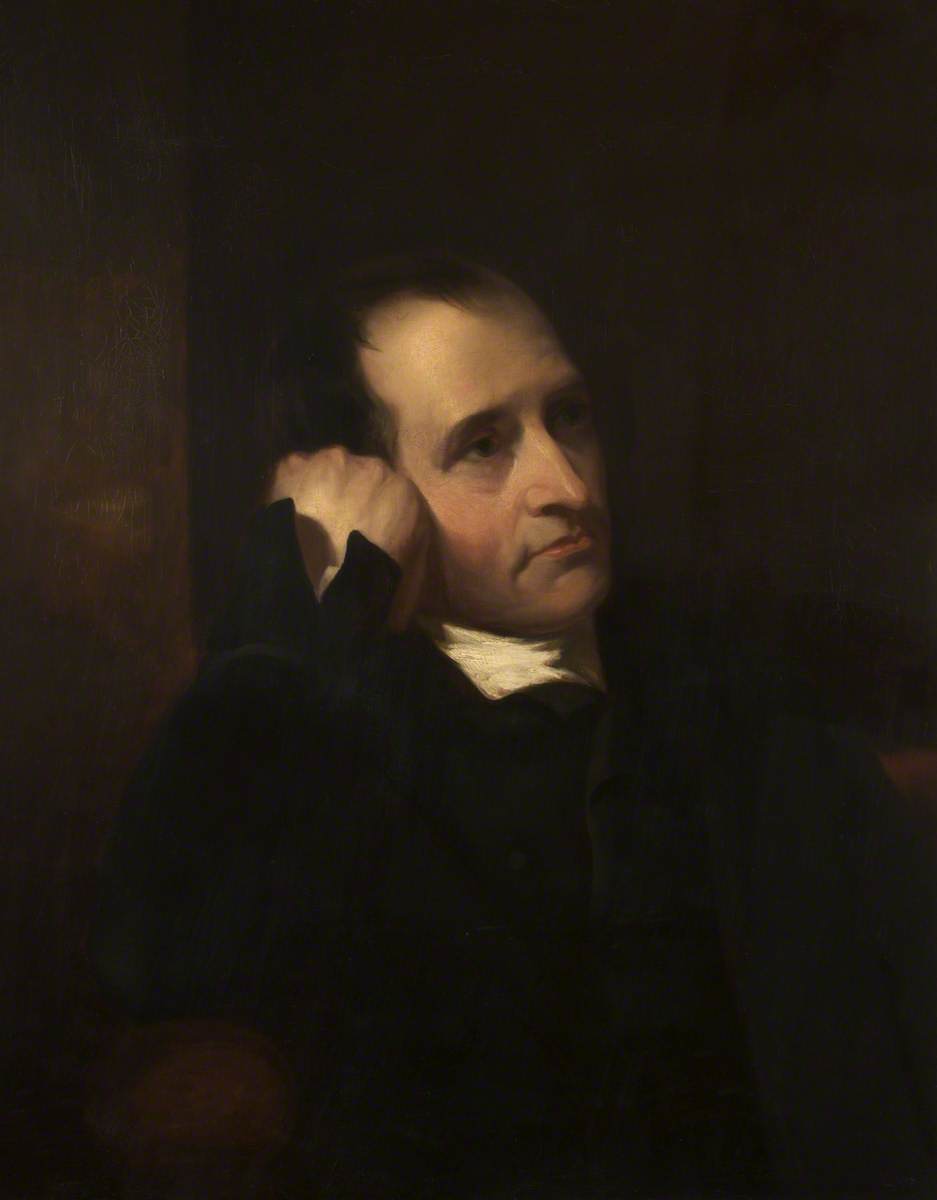
Samuel Crompton c.1800
Portrait by Charles Allingham

A diagram of an early spinning mule. Early mules were often hand made by individual craftsmen who had both the wood and metal working skills required to construct such complex machines. This could lead to significant variation between machines.
By Baines – www.handweaving.net Upload User:ClemRutter, Public Domain, https://commons.wikimedia.org/w/index.php?curid=6641264
The spinning mule was a development of the Spinning Jenny and the water frame taking aspects of each and combining them into a single machine hence the name ‘mule’. From the water frame Crompton adopted the rollers that perform the initial stretching of the cotton roving before it is twisted to form thread. Whilst from the Spinning Jenny he took the movement of the carriage that teases out the cotton and then holds it until the twist is applied by spindles on the machine. Unlike the carriage of the Jenny however the mule’s carriage is larger and heavier, carrying the spindles that both twist and take up the spun thread as the carriage returns to its original position. Unlike its predecessors however the mule was not as limited in the thread it could produce. The Spinning Jenny could produce fine quality thread but this could vary greatly between drawing cycles with some attempts producing high quality thread whilst the next cycle of the machine produced very low-quality thread. Water frames on the other hand produced large quantities of thread of consistent type but of a quality well below what a hand spinner could achieve. By combining the best attributes of both machines the mule was able to produce large quantities of high quality thread.
The inventor of the mule, Samuel Crompton was born in 1753 to a family of Lancashire weavers and small holders. His father died when he was young. By the age of 10 he had learned how to weave on a loom. Having an inquisitive mind Samuel began to develop a machine for spinning cotton thread, something for which there was much demand in England at the time, eventually coming up with a machine that mimicked the motion of a spinner’s hands by first teasing out and then twisting the thread. By 1779 Samuel had a working prototype. Unfortunately, he did not patient his invention. The rollers that teased out the cotton fibres, largely inspired by Arkwright’s machine, were heavily protected by numerous patents that Arkwright vigorously, and successfully defended in court. This left Samuel in the difficult position of not being able to make money by licensing his invention to mill owners but instead using his invention to spin cotton at home and try to keep it away from prying eyes. Through a series of failed business deals he was unable to protect the secrets of his invention and by 1802 the mule was being used in mills across Lancashire without Samuel receiving any royalties. By 1812 within 60 miles of Bolton there were 650 spinning mills with 4.6 million spindles on mules. After an appeal to Parliament Samuel was awarded £5,000 for his invention, a paltry sum for the true value of the mule to the British economy. Trying to set up business in areas away from cotton spinning, Samuel was unsuccessful and by the time of his death in 1823 had only £25 in valued assets.

Sunnyside Mills c.1860
Vast mills such as Sunnyside Mills in Bolton were built to spin cotton using mules.
What made the mule revolutionary was its ability to produce vast amounts of fine quality thread that could be spun in a single cycle of the machine. Early machines were hand operated by turning a large hand cranked wheel on one side of the machine and then manually controlling the operation of the machine through a series of leavers. Further developments took place after Crompton’s death with the development of the self-acting mule by Richard Roberts, a machine maker, in 1825. This allowed the mule to operate with minimal intervention from its operator turning the once skilled worker into a supervisor for the machine, simply removing full bobbins of cotton, replacing empty bobbins of roving and ensuring that any breaks in the thread were repaired as quickly as possible on each of their over 1,300 spindles.
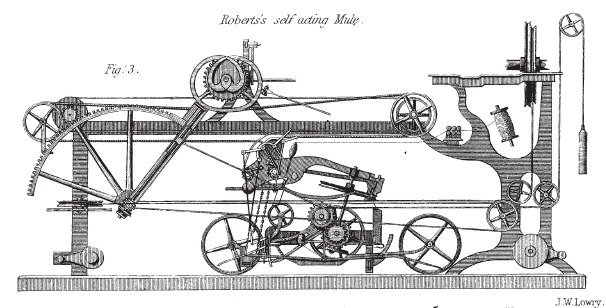
A diagram of a self-acting mule. By Baines – www.handweaving.net Upload User:ClemRutter, Public Domain, https://commons.wikimedia.org/w/index.php?curid=6641188

The self-acting mule in action
A self-acting mule demonstrated at the Manchester Museum of Science and Industry.
The mule on display in Strutt’s North Mill is not one of these 1,300 spindles automatic leviathans but is instead a hand operated training mule used to train mule spinners. It is made from a solidly built three-sided wooden frame that supports the machine. At the rear of the machine is the creel holding the bobbins of roving waiting to be spun into thread. Below these are the rollers that stretched the cotton to tease out fibres: this machine has three pairs that are geared to run at different speeds to pull the cotton to the correct length. This is then taken up by the wooden carriage that moves out on a pair on iron rails secured into the floor under the machine. This carriage also contained the spindles that took up the spun cotton on a cardboard cone that would be jammed over the spindle.
The spinning mule is one of the truly revolutionary pieces of machinery in the world. Although the museum has examples of both the Spinning Jenny and a water frame both of these machines were flawed which limited their usefulness. The mule allowed for the production of high-quality cotton thread that could be used for many applications. It was this cheap and plentiful supply of cotton that fuelled a boom in the number of clothing items that could be produced on power looms and knitting frames, making cotton clothing available for many people at an affordable price. Within a generation, Spinning and weaving went from being a cottage industry to a factory product in sprawling industrial cities with hundreds of factories producing miles of spun thread and finished cloth, changing the landscape of northern England, and the world, forever.