Smile: the 1896 Strutt worker photographs
Our Favourite Things, the continuing exploration of the collections of Strutt’s North Mill, moves away from the larger objects in the collection to a unique series of photographs of the Strutt family’s Belper and Milford employees, taken in October 1896. These photographs, which include almost every department in the mill and name each of the workers provide a valuable visual record of the mill community.
The end of the 19th century marked a massive change for the Strutt enterprises. After more than a century of family ownership, from the completion of the original South Mill in 1778 by Jedediah Strutt and through the expansion and experimentation that led to the sprawling industrial complex owned by his sons, William, George and Joseph’ the Strutt family’s time as mill owners was coming to an end. By the end of the 19th century the mills were owned by George Herbert Strutt, Jedediah’s great grandson and the business landscape had changed radically since it all began in 1778. Large spinning mills in Lancashire using larger, modern machines could produce thread at a far cheaper price than the ageing mills in Belper while foreign competition, using more modern spinning techniques and efficient building layouts was further driving down prices and reducing profits. To combat this fourteen business, all involved in various areas of cotton production formed the English Sewing Cotton Company (ESCC). Led by its chairman, Algernon Dewhurst, owner of Dewhursts, and with George Herbert Strutt as treasurer, this new conglomeration of companies aimed to be collectively more competitive in the face of increasingly strong foreign competition.
Before their Belper and Milford mills became part of the ESCC partnership, the Strutts hired a professional photographer, Corliss of Long Eaton, to travel to Belper and Milford to take a series of photographs of their employees. Each photograph shows a group of workers from the mills. They are dressed in their best clothes, neatly turned out: the girls and women in long dresses with tight corsets to achieve the fashionable look of the day. Many of the women also wear brooches, possibly some of their best jewellery and family heirlooms that may survive to this day. The men and boys in their best suits, holding their hats and with pocket watch chains visible of many on the more senior managers. All are lined up in rows, reminiscent of a school photograph. In the front row of every photograph of the Belper mills employees is Mr Needham, the mill overseer. There are also children in the photographs. Although the numerous Factory Acts of the 1800s attempted to regulate working conditions and stop young children under nine years of age (raised to twelve in 1901) working in factories, older children could still be employed but could only work for a limited number of hours each day. These Acts laid the basis for many aspects of work that we now take for granted such as meal breaks, health and safety and time off, i.e. Bank Holidays, although paid holidays did not arrive until the 1930s.


A group of mill workers from the 6th floor of the West Mill. The Belper mill overseer, Mr Needham, is seated 3rd from the left.
Workers present in this photograph from left to right rear row to the front:
- M. Gration; A. Barrett; E. Smith; L. Bridges; M. Cope; M. Cooper; E. Co
- W. Hobson; B. Watson; Isaac Needham; E. Simpson; N. Clark; H. Hobson
A mixed group of workers from the West Mill, the front two rows include a number of children and young people
Workers present in this photograph from left to right rear row to the front:
- L. Haynes; E. Gration; S. J. Otterwell; E. Glew; M. A. Gration; H. Beeton; K. Stone; R. Sims
- M. Swift; M. Cope; E. Swift; M. Yomans; R. Cope; E. Jackson; H. Levers
- H. Armstead; E. Booth; S. A Glew; M. Leam; R. Yomans; A. Ryde; W. Wilkerson; A. Smith
- G. Bennett; A. Cope; E. Beardmore; W. Booth; S. Bowmer; W. Simpson; Isaac Needham

A photograph of mostly female Belper mill workers from the South Mill.
Workers present in this photograph from left to right rear row to the front:
- L. Beardmore; A. Allen; F. Key; E. Smith; A. Mills; E. Millington; A. Stone; R. Stone
- E. Smith; L. Bryan; M. Butler; S. Finders; R. Cope; E. Bates; L. Hurst; E. Bowmer
- A. Fox; E. Fox; E. Nally; A. Hobson; M. Hobson; M. Watson S. Street. S. Mellor; H. Woodward.
- H. Smith; J. Blythe; Isaac Needham; J. H. Moss; G. Bacon
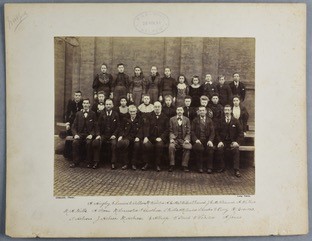
A Group of mill workers from the Strutt family’s Milford Mills. Present in the centre of this image is Elijah Allsopp, the manager of the dying and bleaching department. Born in 1824, by the time of his death in 1911 he was of the few people alive able to remember Princess Victoria’s visit to the mill. Elijah started working for the Strutt family aged 8, working in the Milford Mills for his entire working life retiring after 57 years in June 1899.
These photographs are an invaluable record of the Strutt family’s workers and a wonderful resource for family historians, at a period when photography was still a comparatively expensive commodity little enjoyed by ordinary working families; and when having your photograph taken was a very special event and one to dress up for. They allow us to give faces to the names of these who worked for the Strutt family. This can be combined with other surviving records such as census data and pay legers for the period, to find where each person lived and their roles within the Strutt’s Mills. This can allow us to build of a detailed picture of the lives of the workers and give a face to many of the workers. Many of the younger workers in the photographs of 1896 would be just within living memory of people alive today; some Belper residents may even be able to remember some of the people with in the photographs.
Copies of these images together with a full transcript of the names of all of the employees are available to view at Strutt’s North Mill. Contact us for an appointment if you’d like to explore further any of your relatives who worked in the mill?